
Impacts by debris and meteoroids pose a significant threat to satellites, space probes, and hypersonic craft. Such high-velocity impacts create a brief, intense burst of light, known as an impact flash. These flashes contain information about both the target and the object that caused the impact. For example, scientists have studied the impact of meteoroids on the moon by monitoring and analyzing impact flashes on its dark side.
A team of Johns Hopkins Whiting School of Engineering researchers led by mechanical engineering doctoral student Gary Simpson, Professor of Science and Engineering K.T. Ramesh, and colleagues have discovered that impact flashes are created by the fragmentation of an ultra-fast jet of material ejected from the colliding bodies. Their results appear in PNAS Nexus.
Video credit: Whiting School of Engineering
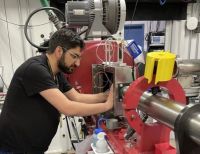
Working in the Hopkins Extreme Materials Institute's HyFire lab, the team shot stainless steel spheres into an aluminum alloy plate at a speed of three kilometers per second—about 6,700 miles per hour, or more than nine times the speed of sound. The resulting impact flashes were photographed using ultra-high-speed cameras and high-speed spectroscopy, which measures the color and brightness of the light.
Immediately after impact, a luminous disc is seen expanding around the impacting sphere. Only a few millionths of a second later, the disc takes on an almost floral shape, as fragments ejected from the impact crater form an ejecta cone, with petal-like projections at the outer edge.
"We found that minuscule, condensed fragments from the jet interact with the atmosphere to create an extremely bright radiating cloud of vapor, which expands at a speed of over ten kilometers per second, or more than 22,000 miles per hour," said Simpson. "The material making up the target and the size of the jetted particles can be inferred from the flash."
Other authors of the study include Justin Moreno, HEMI associate staff engineer, and Matthew Shaeffer, HEMI senior staff engineer. Both are faculty members in applied biomedical engineering at the Whiting School's Engineering for Professionals program.
Posted in Science+Technology
Tagged space exploration