
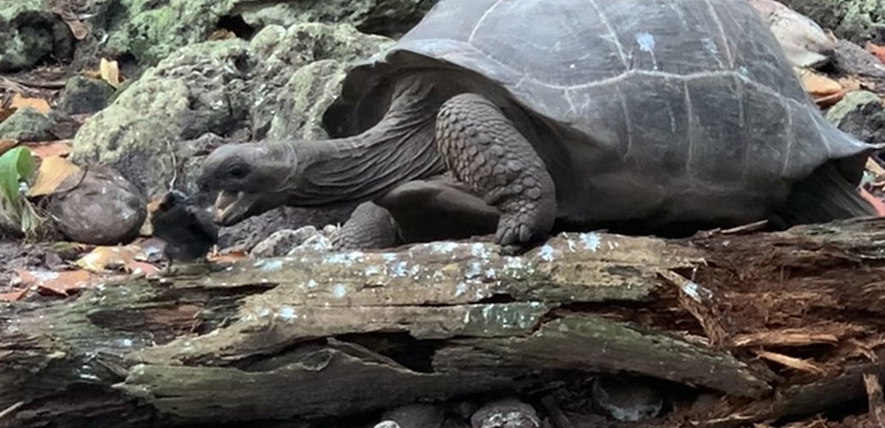
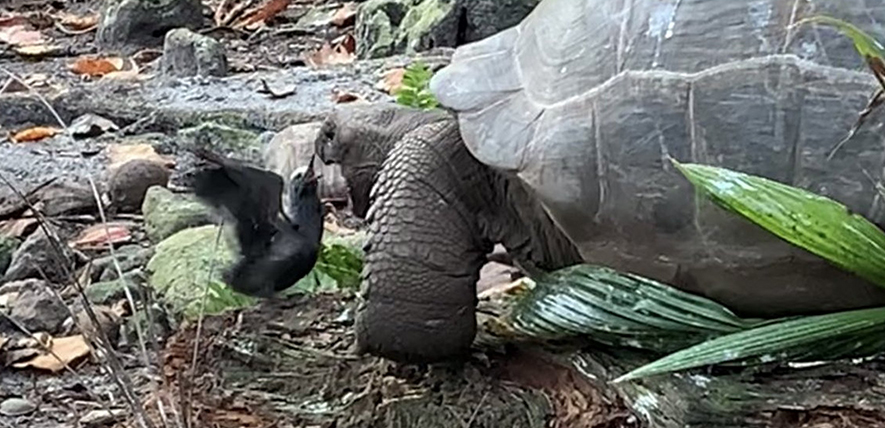
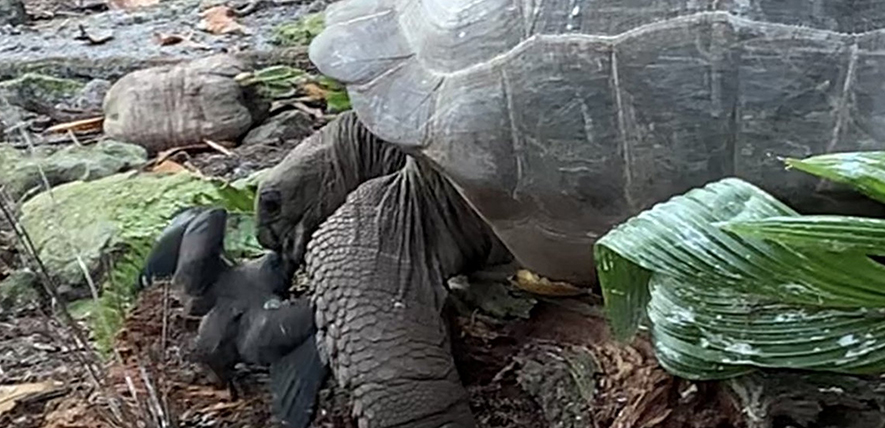
The hunting tortoise was seen in July 2020 on Frégate Island, a privately owned island in the Seychelles group managed for ecotourism, where around 3,000 tortoises live. Other tortoises in the same area have been seen making similar attacks.
“This is completely unexpected behaviour and has never been seen before in wild tortoises,” said Dr Justin Gerlach, Director of Studies at Peterhouse, Cambridge and Affiliated Researcher at the University of Cambridge’s Museum of Zoology, who led the study.
He added: “The giant tortoise pursued the tern chick along a log, finally killing the chick and eating it. It was a very slow encounter, with the tortoise moving at its normal, slow walking pace – the whole interaction took seven minutes and was quite horrifying.”
The interaction was filmed by Anna Zora, conservation manager on Frégate Island and co-author of the study.
“When I saw the tortoise moving in a strange way I sat and watched, and when I realised what it was doing I started filming,” said Zora.
The finding is published today in the journal Current Biology.
1 of 3
2 of 3
3 of 3
All tortoises were previously thought to be vegetarian - although they have been spotted feeding opportunistically on carrion, and they eat bones and snail shells for calcium. But no tortoise species has been seen actively pursuing prey in the wild before.
The researchers think that this entirely new hunting behaviour was driven by the unusual combination of a tree-nesting tern colony and a resident giant tortoise population on the Seychelles’ Frégate island.
Extensive habitat restoration on the island has enabled sea-birds to recolonise, and there is a colony of 265,000 noddy terns, Anous tenuirostris. The ground under the colony is littered with dropped fish and chicks that have fallen from their nests.
In most places, potential prey are too fast or agile to be caught by giant tortoises. The researchers say that the way the tortoise approached the chick on the log suggests this type of interaction happens frequently.
On the Galapagos and Seychelles islands, giant tortoises are the largest herbivores and eat up to 11% of the vegetation. They also play an important role in dispersing seeds, breaking vegetation and eroding rocks.
“These days Frégate island’s combination of tree-nesting terns and giant tortoise populations is unusual, but our observation highlights that when ecosystems are restored totally unexpected interactions between species may appear; things that probably happened commonly in the past but we’ve never seen before,” said Gerlach.
This research was supported by Fregate Island Foundation.
Reference
Zora, A. & Gerlach, J.: ‘First documented observations of giant tortoises hunting and consuming birds.’ Current Biology, August 2021, DOI: 10.1016/j.cub.2021.06.088