
- Name
- Doug Donovan
- [email protected]
- Office phone
- 443-997-9909
- Cell phone
- 443-462-2947
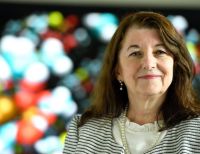
Lauren Gardner, the Johns Hopkins University professor who pioneered infectious disease tracking during the COVID-19 pandemic, won the Future Insight Prize from Merck, the global life sciences conglomerate based in Germany.
Merck awarded the €500,000 prize (approximately $541,160) to Gardner today for her contributions to the development of artificial intelligence systems capable of discovering and tracking future pandemics.

"Receiving the Future Insight Prize will further support our mission at Johns Hopkins to refine predictive modeling and enhance decision making tools that are crucial for effectively managing public health emergencies," Gardner said at the Curious2024—Future Insight Conference. "This recognition fuels our commitment to developing new AI-enabled solutions to anticipate and mitigate future threats from any known virus or other biological source."
Gardner has been at the forefront of epidemiological modeling well before the COVID-19 pandemic emerged in December 2019. Earlier that year she created a predictive map that determined the 25 U.S. counties where measles outbreaks were most likely to occur due to multiple variables. She has also previously developed predictive models for Zika, Dengue, MERS-CoV among other infectious diseases. In January 2020, as COVID-19 was still primarily contained to Asia, Gardner and her team in the Department of Civil and Systems Engineering created the Johns Hopkins web-based COVID-19 dashboard, an essential global resource that earned her the Lasker-Bloomberg Public Service Award, America's top biomedical research prize.
"The exemplary work of Dr. Gardner and her Johns Hopkins team made a significant public health contribution during the COVID-19 pandemic," Merck CEO Belén Garijo said. "With the Future Insight Prize, we hope she can accelerate ongoing efforts to create a world that is better prepared to predict and prevent future pandemics."
Gardner's current projects include enhancing epidemiological tools for early outbreak detection, creating a centralized open data repository, and advancing public health policy integration through training and capacity-building efforts. Her work aims to set new standards in using AI for public health and foster robust global responses to emerging infectious diseases.