
UBC experts team up to tackle air pollution with network of sensors
Science, Health & Technology
Air pollution is an urgent problem linked to as many as nine million deaths per year worldwide and 14,000 annually in Canada, primarily from related heart and lung diseases. A group of UBC experts are determined to mount a rapid response through research.
The team, known as Rapid Air Improvement Network (RAIN), is planning to use a network of air quality sensors, mobile monitoring and sophisticated analysis instruments to locate and study air pollutants with the detail needed to support fast, effective interventions.
They plan to install an air quality sensor network on the UBC campus this summer, to leverage the university’s traffic, population and operations data which can be quickly tuned to improve air quality. The project will also outfit a mobile monitoring station that will be used further afield, including communities affected by wildfires and other areas in urgent need.
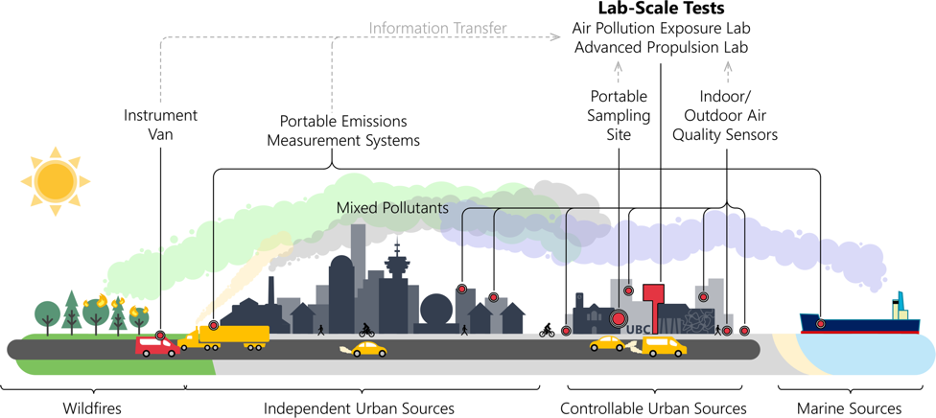
“Air pollution is chemically and physically complex, and concentrations outdoors and indoors can vary dramatically with location and over time,” says principal investigator Dr. Steven Rogak, a professor of mechanical engineering in the faculty of applied science. “With RAIN, we are looking to produce meaningful information that can help the public, industry and governments take smarter actions on health and climate around the world.”
The RAIN team includes experts in health, chemistry, meteorology, engineering and environmental policy, working with academic, government and industry partners. These partners will help translate the data into effective interventions, including control strategies for engines, traffic flow and building ventilation.
Rogak, an aerosols expert, adds that air quality has become even more important in the midst of the ongoing COVID-19 crisis.
“We are looking for solutions that improve air quality and promote healthy homes and workplaces through the current pandemic, and after. And they should be relevant not only in Canada but also beyond, including in lower-income countries.”
RAIN members include co-principal investigator Dr. Naomi Zimmerman (mechanical engineering), Dr. Allan Bertram (chemistry), Dr. Nadine Borduas-Dedekind (chemistry), Dr. Michael Brauer (school of population and public health), Dr. Christopher Carlsten (medicine), Dr. Amanda Giang (mechanical engineering, and Institute for Resources, Environment and Sustainability), Dr. Patrick Kirchen (mechanical engineering), Dr. Ian McKendry (geography) and Dr. Adam Rysanek (school of architecture and landscape architecture).
The project is receiving $2 million in new infrastructure funding from the Government of Canada through the Canada Foundation for Innovation (CFI).
“We’re excited! The RAIN team has been taking science and engineering to communities to solve real problems for many years, but this funding will really help take this approach to a new level that will be a model for researchers around the world,” said Rogak.