
Acoustics researchers of Aalto University have discovered a way to improve the most common measurement method, the sine sweep technique, which has been in use for 20 years since it replaced all previous methods.
The sine sweep is a whistling sound, whose frequency raises logarithmically through the entire range of the human hearing from 20 Hz to 20,000 Hz. In practice, the sine sweep lasts for a few seconds. By increasing the length of the sine sweep, it is possible to feed more energy to the room and thus reduce the proportion of noises affecting the measurement. However, the measurement cannot be increased much, since over the time the possibility of additional disturbances and changes in the environments increase, which adds to the uncertainty of the measurements.
The new Rule of Two method recommends repeating the sine sweep measurement a few times until two of them pass the cleanliness criterion. This way, the automatic measurements can be done very reliably.
The thousands of combinations needed for the development of this method were measured at the Arni room in Otaniemi.
“The measurement techniques of acoustics and audio technology have developed much over the years. In the early days, acousticians used to clap their hands or use a starting pistol in a room and then listen how the echo decays. Nowadays the measurements are done with a computer and accurate calculations, and that’s why we know precisely how sound reverberates in different spaces,” says Vesa Välimäki, a professor of acoustics.
“The name of our method, Rule of Two (Ro2), comes from the requirement that reliability calls for two clean measurements, which correlate strongly. Later we learned that, by coincidence, there is also a rule of two in Star Wars. The acoustic measurement method has nothing to do with Star Wars, except for the same term” says Karolina Prawda, a doctoral researcher.
Researchers believe that the new measurement technique for acoustics and audio technology will replace the 20-year-old single sine sweep method, because the more reliable technique saves time in design work. Acoustic measurements are commonly used in the design of all interiors, where it is necessary to make speech, announcements or music audible for all, such as in movie theatres, metro stations, concert halls, lecture rooms, churches, and congress centers.
“At Aalto University, we will immediately start using this method in teaching. I hope that the sector of acoustics will notice its benefits as soon as possible,” Professor Välimäki says.
Endless amount of echo options with rotating panels
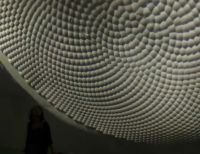
The walls of the Arni room have rotating panels. One side of the panels is hard whereas the other is soft. The room becomes reverberant using the hard surfaces and attenuated using the soft ones. A spherical loudspeaker plays sound to all directions, and the acoustic properties can be measured with several microphones at the same time. Because of the rotating panels, researchers have the chance to modify the acoustic environment in the room almost endlessly.
“The measurement method was discovered just because of thousands of measurements. The walls can produce more combinations than there are ants in the world,” mentions Professor of Practice Sebastian Schlecht.
“The wall panels open and close when the software commands them. Our task was to analyze the thousands of measurements and compare them with each other,” Prawda says.
The paper has been published in the prestigious Journal of the Acoustical Society of America. The paper can be read by clicking this link.
More information:
Karolina Prawda
Doctoral researchers, Aalto University
[email protected]
Vesa Välimäki
Professor, Aalto University
[email protected]
050 569 1176
Sebastian Schlecht
Professor of Practice, Aalto University
[email protected]
050 517 6093