
Testing times
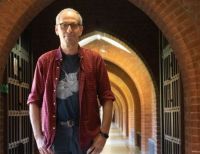
Prior to the pandemic, Matheson was a principal investigator in the Department of Medicine studying HIV. He is also an honorary consultant at Addenbrooke's Hospital, where his clinical work is focused on infectious diseases. As such, he was involved early on with the response to the pandemic, including as part of a team screening healthcare workers at the hospital for infection.
At the start of summer, the University, led by Matheson’s colleague Dr Mike Weekes, set up two dedicated testing hubs to test staff and students with possible symptoms of COVID-19. But a major factor that led to the global pandemic was arguably the phenomenon of transmission from individuals without symptoms, whether it was before symptoms emerged or because an individual never showed any symptoms. In October, an estimated 18,000 students were due to descend on Cambridge – many for their first time living away from home. The majority of these would be living in accommodation provided by one Cambridge’s 31 Colleges. It soon became clear that asymptomatic transmission could lead to an explosion in the number of cases at the University.
In response to these concerns, Matheson proposed a mass screening programme for the University using PCR tests – the ‘gold standard’ for testing due to their accuracy. The University, in partnership with GSK and AstraZeneca, had established the Cambridge COVID-19 Testing Centre at the Anne McLaren Building on the Cambridge Biomedical Campus. Part of the contract negotiated with the government was that, subject to national capacity, a limited number of tests per day could be used for the University to screen its students. But even so, it was not going to be possible to screen 18,000 students per week.
“Although we thought this might be a good idea, it didn't seem at the time logistically feasible,” he says.
The breakthrough came when Matheson hit upon the idea of combining students into testing ‘pools’. Each student is assigned to a ‘household’ – usually between six and ten other students who share kitchen and bathroom facilities. Participating students would swab themselves and then pool their samples – this meant that rather than testing, 18,000 individual samples, the team would only need to process 1,000-2,000 pooled samples each week. If a household sample tests positive, then those students who swabbed would take an individual confirmatory test – if they or anyone else in their household tested positive in this follow-up, they would have to isolate for the required time.
The decision was taken early on to test only those students living in Colleges, rather than including those living in private accommodation. This was a pragmatic decision, but based on available evidence, says Dr Ben Warne, a colleague of Matheson’s brought on board to help run the programme.
“We’d seen from reports in the United States and data coming out from the UK that the people at highest risk [of infection] seemed to be university students aged between 18 and 25,” he says. “So we wanted to focus our attention particularly on those students living in College accommodation – people who mixed with other students on a regular basis.”
Even so, this still accounted for 15,000 students. Setting up the programme in time for the return of students would be a Herculean task involving dozens of people across the University.
“Screening programmes normally take years to set up and design and pilot and run,” says Warne. “The major pressure was time – we wanted to put in an effective programme for our students to benefit the community in a very, very tight timeframe. But one of the great things about working for the University of Cambridge is that there are a large number of enthusiastic people with various skill sets that we were able to call upon.”
Overseen by the Head of the School of Clinical Medicine, Professor Patrick Maxwell, this huge team effort has involved colleagues from across the University – from the Faculty of Law to University Information Services, COVID Operations, Communications, Cambridge Student Union and the Colleges to name but a few.