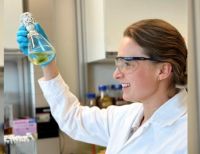

Serina realised she wanted to be a scientist while doing field work in the Alaskan tundra as a research assistant during her Bachelor’s studies. Despite standing knee deep in boggy marshland, she was in her element collecting soil samples. She was just as excited back in the laboratory when analysing the nutrients present in the samples she had taken. “I really got the bug,” she recalls.
Robinson is currently engaged in research at the Institute for Microbiology, where she works as a postdoc as part of her ETH Fellowship. Working at ETH Zurich has been both her dream and ultimate goal for a long time. “It’s really exciting to finally be here!” she says. During her one-year postdoc position with Jörn Piel’s group, she is researching enzymes and small proteins, so-called peptides, produced by specific microorganisms. These microorganisms do not grow in the laboratory and thus the peptides they produce are under-researched, or simply unknown.
Metagenomics opens the way to new discoveries
Scientists currently use metagenomics to study microbes that cannot be grown in the lab: “Metagenomes are a type of snapshot that captures the DNA of all microorganisms present at a certain time in a specific ecosystem, such as soil, wastewater or even the human gut,” Robinson explains. The DNA from samples are extracted, sequenced, and can be used to reassemble the genomes of the individual organisms on the basis of overlaps between the individual segments.
The gene sequences of the microorganisms Robinson is working with originate from the metagenomic database of another group at the Institute for Microbiology: Shinichi Sunagawa and his colleagues have collected metagenomes from over 1,000 different marine locations. Robinson searches this source for DNA blueprints for peptides that could be interesting as active ingredients for medicines.
She is currently working on a bacterium that was originally only discovered through metagenomics. “It is very different from previously known microorganisms,” she explains. What’s more: it produces a new type of peptide in a family of compounds which were discovered by the Piel lab. Last year, the Piel and Oxenius labs found that a different peptide in this family has antiviral activity, making this class of peptides an important and medically-relevant area of research.
Alternatives to E. coli
Robinson uses synthetic biology tools to manufacture this peptide in the laboratory. This involves introducing the relevant genes, either individually or in differently composed groups or “clusters”, into the host organism. If everything goes to plan, this organism then makes the desired active substance.
The E. coli bacterium is generally used as a host for this. “But E. coli is not able to generate active proteins from all organisms,” Robinson explains. Similarly, E. coli is not capable of producing the final form of the peptide of the bacterium the scientist is working with (which is impossible to grow in the lab), so she is working with an alternative host developed by the Piel research group.
All about microorganisms
Robinson has often asked herself why she is so fixated by microorganisms. “I find it simply fascinating to work with them in the laboratory: they look so simple from the outside – tiny specks on an agar plate. But what goes on inside them is so incredibly complex,” she says by way of explanation.